Olive oil polyphenols, mainly hydroxytyrosol and its derivatives, earn a specific European Food Safety Authority claim: they contribute to the protection of blood lipids from oxidative damage, but only when a person consumes at least 5 mg of hydroxytyrosol equivalents daily. That threshold, not a vague notion of “antioxidants,” is the practical bar worth understanding. Compounds like oleuropein and oleocanthal round out the picture, but the claim itself is narrow: it addresses one biomarker, not a promise against heart disease or cancer.
TL;DR:
-
Only oils containing at least 5 mg of hydroxytyrosol equivalents per daily serving can claim they protect blood lipids from oxidative damage.
-
Polyphenol levels vary widely depending on olive cultivar, harvest timing, and processing, with early-harvest, cold-pressed oils generally retaining more compounds.
-
Laboratory testing with HPLC provides the most accurate measurement of polyphenol content, while Folin-Ciocalteu methods tend to overestimate.
-
Sensory cues like bitterness and pungency can help identify higher-polyphenol oils, but verified provenance and recent harvest dates are more reliable indicators.
-
Consistent and transparent sourcing, combined with proper storage and use, maximizes polyphenol preservation and potential health benefits.
Table of Contents
What polyphenols are in olive oil: chemistry and taste
Polyphenols are plant compounds built around phenol rings, and olive oil carries several distinct families of them. The simple phenols, hydroxytyrosol and tyrosol, are the most studied and the ones EFSA’s claim is built around. Alongside them sit the secoiridoids, a group that includes oleuropein aglycon, oleacein, and oleocanthal, compounds unique to olives and largely responsible for the oil’s bite. Smaller amounts of flavonoids and lignans round out the profile, contributing color and additional antioxidant activity.
These compounds do not start out in the fruit the way they end up in the bottle. Olives store hydroxytyrosol and tyrosol mostly as glucosides, bound to sugar molecules, and it is during milling and malaxation (the slow mixing of crushed olive paste) that enzymes convert those glucosides into the free phenolic forms found in finished oil. That conversion step is one reason processing choices matter so much for final polyphenol content, a point covered in more depth later.
There is a rough sensory shortcut for spotting phenol-rich oil, and it comes down to taste rather than a lab report. Oleocanthal is largely responsible for the throat-catching pungency that makes you cough when you swallow a spoonful of intense extra virgin olive oil, an effect often compared to the sting of ibuprofen. Oleuropein derivatives contribute bitterness, especially in oils pressed from unripe, green fruit. A tasting session at home can teach you to recognize both cues within minutes, and while taste is not a substitute for lab data, a flat, buttery oil with no bitterness or pungency is rarely a high-polyphenol one.
The main compound groups worth knowing:
-
Simple phenols: hydroxytyrosol and tyrosol, the compounds behind EFSA’s protective claim.
-
Secoiridoids: oleuropein aglycon, oleacein, and oleocanthal, unique to olives and tied to bitterness and pungency.
-
Flavonoids and lignans: minor contributors to antioxidant capacity and color.
-
Glucoside precursors: bound forms in the raw fruit that convert to active phenols during milling.
Sensory intensity is not a precise measurement, but it is a free one. Oils that taste sharp, bitter, or slightly astringent on the back of the throat are more likely to sit on the higher end of the polyphenol range than oils that taste mild or neutral.
What the science actually shows: EFSA and human studies
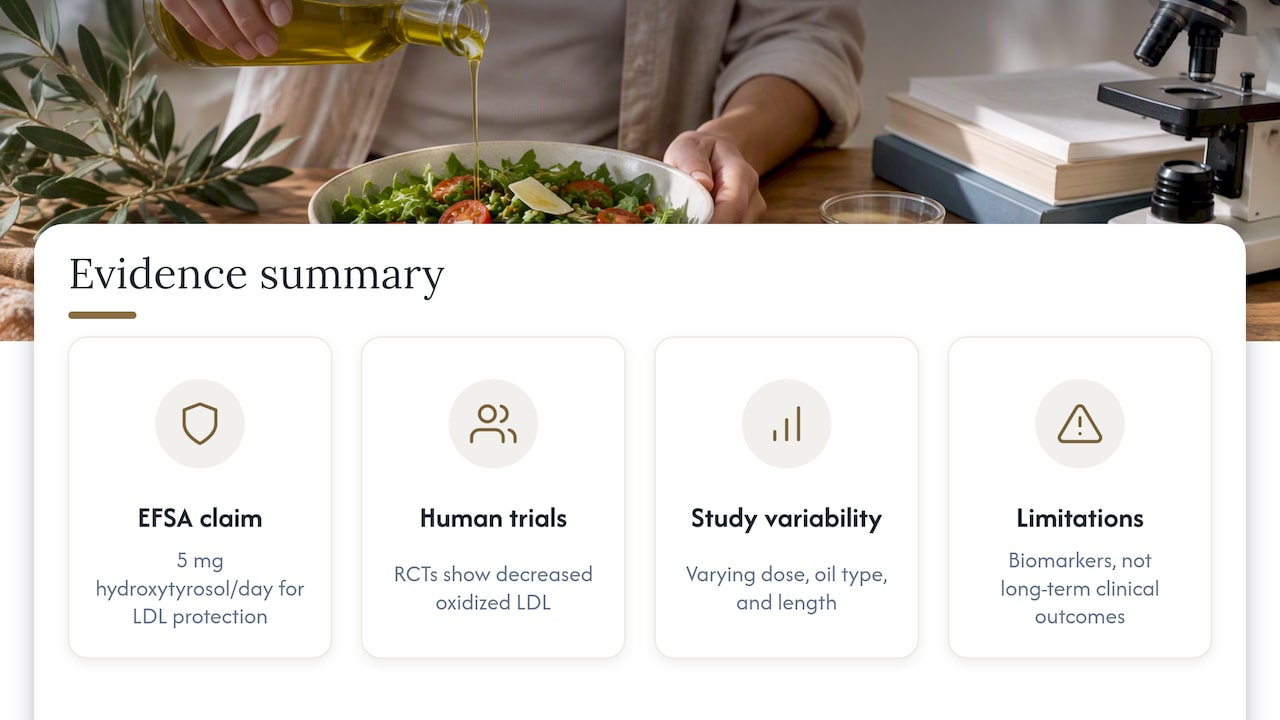
The European Food Safety Authority’s opinion is the most concrete regulatory statement in this space, and it is worth quoting closely. EFSA concluded that consumption of olive oil polyphenols contributes to the protection of blood lipids from oxidative damage, specifically hydroxytyrosol and its derivatives, when at least 5 mg of hydroxytyrosol equivalents are consumed daily. That 5 mg figure was derived from the body of human intervention evidence available to the panel, and it is deliberately narrow: it names one mechanism (protecting LDL particles from oxidation) rather than a general health halo. EFSA also flagged that some commercial oils carry too little polyphenol content for a normal serving to reach that 5 mg target, which means the claim does not apply automatically to every bottle labeled extra virgin.
5 mg per day is the entire regulatory bar. That is the amount of hydroxytyrosol equivalents EFSA determined is needed daily for the LDL-protection claim to apply, and it is a useful number to keep in mind when reading a bottle’s phenolic count.
Human intervention studies back up the underlying mechanism. Randomized controlled trials, including work building on Covas and colleagues, found that participants consuming higher-polyphenol olive oil showed measurable decreases in oxidized LDL, the oxidized form of “bad” cholesterol that is thought to play a role in artery damage. Some trials also reported modest shifts in HDL levels or lipid ratios. These findings are real, but they come from a body of research that varies widely in dose, oil type, and trial length, which makes it hard to pin down one universal effect size.
That variability points to the central limitation in this evidence: oxidized LDL and similar markers are surrogate measures, stand-ins for something researchers cannot easily observe directly, which is whether a person’s actual risk of heart disease drops over years or decades. A biomarker moving in the right direction is meaningful, but it is not the same as a clinical trial showing fewer heart attacks or strokes in people who eat high-polyphenol olive oil. Reviews of the evidence caution against treating antioxidant activity in a lab dish as proof of disease prevention in people, since much of the mechanistic work behind polyphenols comes from cell and animal models rather than long-term human outcomes. The honest summary: the biomarker evidence is solid enough to support EFSA’s narrow claim, and it stops well short of licensing broader promises.
Why levels vary: cultivar, harvest, and processing
Two bottles labeled “extra virgin olive oil” can differ by an order of magnitude in polyphenol content, and the reasons start with the olive tree itself. A large survey of olive fruit across many cultivars found that genotype, the specific olive variety, explains most of the variation in phenolic profiles from one oil to the next. Some cultivars are simply built to produce more secoiridoids than others, and that genetic difference tends to matter more than where the olives were grown.
Harvest timing adds another layer. Olives synthesize hydroxytyrosol and tyrosol derivatives early in fruit development, and phenolic content tends to peak before the fruit fully ripens, then decline as the olives turn from green to black. This is why early-harvest oils, pressed from underripe, green fruit, generally run higher in polyphenols than oils pressed from fully ripe olives late in the season. Climate and growing conditions in a given year shift the numbers further, which is part of why polyphenol content can vary from one harvest to the next even from the same grove.
Processing and storage determine how much of that potential survives into the bottle you buy:
-
Malaxation time and temperature: longer, hotter malaxation extracts more oil but degrades more phenolic compounds.
-
Extraction method: mechanical cold extraction preserves more polyphenols than methods relying on heat or solvents.
-
Light and heat exposure: clear glass and warm storage accelerate phenolic breakdown after bottling.
-
Time since pressing: polyphenol levels decline gradually even under good storage, so older stock rarely matches fresh pressings.
Pro Tip: Check the harvest date on the label rather than the “best by” date. An oil harvested eight months ago has already lost a meaningful share of its original phenolic content, no matter how far off its expiration date sits.
How polyphenols are measured and what labels actually mean
Two very different laboratory methods produce the polyphenol numbers you sometimes see on a bottle or a spec sheet, and knowing the difference helps you judge how much to trust a claim. High-performance liquid chromatography, or HPLC, separates and identifies individual compounds, which means it can report hydroxytyrosol and its derivatives specifically, the exact molecules EFSA’s claim is built around. This specificity is why HPLC-based reporting is the preferred method for any brand or study trying to demonstrate that an oil meets the 5 mg hydroxytyrosol-equivalent threshold.
The other common method, Folin-Ciocalteu, is a colorimetric assay that reacts with a wide range of reducing substances, not just polyphenols. It is faster and cheaper, but it tends to overestimate true polyphenol content because it cannot distinguish hydroxytyrosol from other compounds that happen to react the same way in the test tube. A “high antioxidant” number generated by Folin-Ciocalteu alone is not directly comparable to an HPLC-derived hydroxytyrosol-equivalent figure, and the two should never be treated as interchangeable.
Working out whether a bottle can realistically deliver 5 mg a day takes a bit of arithmetic:
-
Find the oil’s reported hydroxytyrosol-equivalent concentration, ideally from an HPLC lab report, often expressed in milligrams per kilogram.
-
Convert that concentration to a typical serving. A 20-gram serving (roughly one and a half tablespoons) of an oil reporting 250 mg per kilogram works out to about 5 mg of hydroxytyrosol equivalents in that single serving.
-
Compare the result to the 5 mg daily target: an oil on the lower end of common ranges may require two or three tablespoons to reach the same amount.
Trustworthy labels tend to share a few habits: a clear harvest date, a lab certificate available on request or online, hydroxytyrosol-equivalent figures stated explicitly rather than a generic “rich in antioxidants” line, and ideally a direct link to the testing lab. A bottle with none of that is not necessarily low in polyphenols, but there is no way for a shopper to check.
Buying, cooking, and storing to protect polyphenol content
Getting a decent dose of hydroxytyrosol equivalents starts at the shelf. Early-harvest extra virgin olive oil, packaged in dark glass or tins rather than clear bottles, and carrying a visible harvest date rather than only a “best by” date, tends to sit higher on the phenolic scale. Small-batch and single-varietal oils are more likely to publish lab data, since producers making that claim usually have the numbers to back it up.
-
At the store: look for a harvest date within the past year, dark packaging, and lab data if the brand offers it.
-
In the kitchen: use higher-polyphenol oils for finishing dishes, dressings, and dips rather than high-heat frying, since heat degrades some phenolic compounds over time.
-
For everyday cooking: a milder, lower-cost oil can still handle sautéing and roasting, reserving the phenol-rich bottle for where its flavor and chemistry actually show up on the plate.
-
In storage: keep the bottle in a cool, dark cupboard, away from the stove, and reseal it promptly after each use to limit oxygen exposure.
There is a genuine tradeoff between smoke point and phenolic preservation. High heat does not destroy an oil outright, but it accelerates the breakdown of the same compounds that give an oil its pungency and bitterness, so a bottle you are proud of on a salad is rarely the best choice for deep frying. A look at how home cooks handle seasoning oils more broadly makes a similar case for treating flavor-forward oils as a finishing ingredient rather than an all-purpose one.
Pro Tip: Buy phenol-rich oil in a size you will finish within two or three months of opening. An unopened bottle degrades slowly, but once air gets in regularly, the clock on its polyphenol content speeds up considerably.
Palinova’s approach to sourcing olive-derived oils
Palinova works from Palestinian groves and small producers, with a focus on authentic sourcing and sustainable, ethical practices rather than volume production. That starting point shapes how the olive oil offering gets made: attention to harvest timing, cold extraction rather than heat-assisted processing, and an effort to preserve the minor compounds that heavier processing tends to strip out. None of this is presented as an alternative health claim beyond what the research supports. It is simply the production philosophy behind the oil.
A personalized aromatherapy consultation service is offered to assist in matching botanical oils to individual skin or wellness goals rather than a one-size-fits-all recommendation. That same attention to sourcing extends across the seed oil line, where cold-pressed extraction is used to protect the compounds that give each oil its character.
None of this changes the regulatory picture covered earlier. The EFSA claim, the clinical evidence, and its limits apply the same way regardless of where an oil comes from. What sourcing and processing choices can influence is how much phenolic content survives from grove to bottle, and that is the piece Palinova’s approach is built to protect.
The gap between marketing and the evidence
The biggest misunderstanding in this space is treating “high polyphenol” as a health guarantee rather than a chemistry fact about a specific bottle of oil. EFSA’s claim is real, and the biomarker research behind it is credible, but it covers one mechanism, LDL oxidation, not a broad shield against chronic disease. Conventional wisdom skips past that nuance and treats any oil labeled “extra virgin” as automatically therapeutic, which the variability in cultivar, harvest, and processing shows is not the case.
What actually matters, if you are trying to act on this research, is less about hunting for the single highest number on a spec sheet and more about consistency: an oil with a documented harvest date, honest lab reporting, and reasonable storage will beat a higher headline number from a bottle that has spent a year on a warm shelf. Bitterness and pungency are useful, free signals, but they are a starting point, not a substitute for reading the label. Readers should prioritize provenance and freshness over chasing a specific milligram figure that most kitchens have no easy way to verify anyway.
— abdelmuhsen
Bring high-polyphenol thinking into your kitchen and skincare routine
If early-harvest, cold-pressed sourcing is what you are after in an olive oil, that same logic applies across the rest of a Palinova order. The extra virgin olive oil is produced with attention to harvest timing and gentle extraction. These are the same factors this article has walked through as the biggest levers on phenolic content. The same sourcing standards carry into the seed oil line and the skincare range, where cold-pressed botanical oils are chosen for the compounds heat and time tend to strip away.
A few starting points if you want to explore beyond the olive oil bottle itself:
-
Culinary oils: the seed oils category covers cold-pressed options like black seed and anise for cooking and finishing.
-
cuidado de la piel: the skincare line applies the same sourcing standards to topical botanical oils.
-
Personal guidance: reach out for a free aromatherapy consultation if you want a recommendation suited to your specific goals.
Browse the full product range to see current harvest and sourcing details before you order.
Sources
FAQ
Which olive oil is highest in polyphenols?
There is no single fixed answer, since polyphenol content depends heavily on cultivar and harvest timing rather than any one brand or region. Early-harvest, single-varietal oils with a documented lab test tend to sit toward the higher end, but the only reliable way to know is checking the specific bottle’s HPLC-based hydroxytyrosol-equivalent figure.
Which supermarket olive oil is highest in polyphenols?
Most supermarket shelf labels do not publish phenolic testing data, so there is no reliable way to rank ordinary store brands by polyphenol content from packaging alone. Shoppers looking for higher levels generally need to seek out brands that voluntarily publish harvest dates and lab certificates, which most mass-market bottles do not.
How do you know if your olive oil is high in polyphenols?
The most reliable sign is a published HPLC lab result stating hydroxytyrosol-equivalent content, since that method identifies the specific compounds behind EFSA’s claim rather than a broad reactive-substance estimate. Short of lab data, a recent harvest date, dark packaging, and noticeable bitterness or throat-catching pungency are useful, though imperfect, secondary clues.
Is olive oil high in polyphenols good for you?
Human studies show that higher-polyphenol olive oil can reduce oxidative markers like oxidized LDL, which is the basis for EFSA’s approved claim that these compounds protect blood lipids from oxidative damage at a daily intake of 5 mg hydroxytyrosol equivalents. That is a specific, evidence-backed biomarker effect, not a guarantee against heart disease or other chronic conditions, since long-term outcome data in humans remains limited.
Recommended
Preguntas frecuentes
Which olive oil is highest in polyphenols?
There is no single fixed answer, since polyphenol content depends heavily on cultivar and harvest timing rather than any one brand or region. Early-harvest, single-varietal oils with a documented lab test tend to sit toward the higher end, but the only reliable way to know is checking the specific bottle's HPLC-based hydroxytyrosol-equivalent figure.
How do you know if your olive oil is high in polyphenols?
The most reliable sign is a published HPLC lab result stating hydroxytyrosol-equivalent content, since that method identifies the specific compounds behind EFSA's claim rather than a broad reactive-substance estimate. Short of lab data, a recent harvest date, dark packaging, and noticeable bitterness or throat-catching pungency are useful, though imperfect, secondary clues.
Is olive oil high in polyphenols good for you?
Human studies show that higher-polyphenol olive oil can reduce oxidative markers like oxidized LDL, which is the basis for EFSA's approved claim that these compounds protect blood lipids from oxidative damage at a daily intake of 5 mg hydroxytyrosol equivalents. That is a specific, evidence-backed biomarker effect, not a guarantee against heart disease or other chronic conditions, since long-term outcome data in humans remains limited.