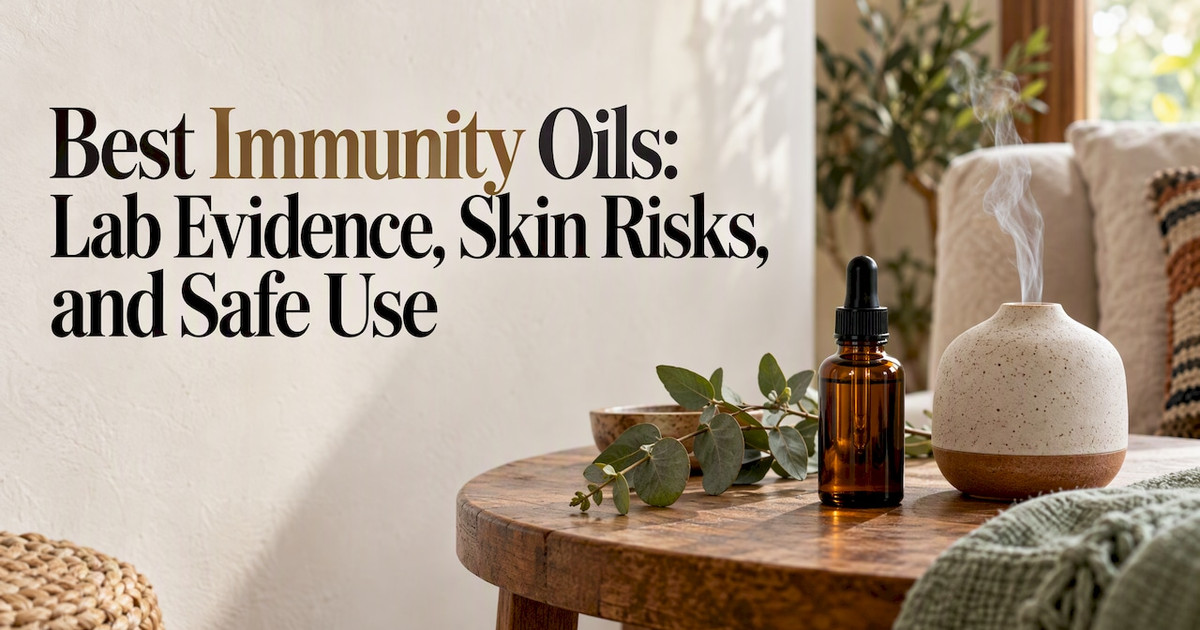

The oils most often studied or traditionally used for immune support include eucalyptus, ginger, clove, tea tree, rosemary, lemon, peppermint, lavender, oregano, thyme, frankincense, and cinnamon. We use these as aromatherapy or diluted topical applications only; none replace vaccines, diagnosis, or medical treatment.
Key Takeaways
Essential oils like eucalyptus and ginger have lab evidence for immune support but are not proven to prevent illness in humans, serving mainly as comfort supplements.
|
Point |
Details |
|
Use with caution |
Always dilute essential oils before topical application and perform patch tests to prevent skin irritation. |
|
Inhalation for short periods |
Diffuse eucalyptus or peppermint in ventilated spaces for congestion relief, limiting sessions to 15–30 minutes. |
|
Avoid ingestion |
Swallowing essential oils like eucalyptus or tea tree can cause serious health issues, requiring prompt medical attention. |
|
Prioritize proven methods |
Vaccination, sleep, and proper nutrition remain the most effective strategies for strengthening immunity. |
|
Source quality matters |
Choose oils with clear botanical names, extraction details, and batch documentation to ensure safety and potency. |
Table of Contents
What the research and tradition say about each oil
Each of these oils carries a different mix of folk use and lab evidence. Knowing which is which helps you pick a realistic use case instead of expecting a cure.
Eucalyptus is one of the better-studied oils for immune-function markers, with lab and animal research looking at its effect on phagocytosis and inflammatory cytokines. It is traditionally inhaled for respiratory comfort during colds. Ginger oil shows similar standing in that same review, with plausible anti-inflammatory activity, and is typically diffused or diluted for massage rather than swallowed.
Clove bud oil is rich in eugenol and is often cited for antimicrobial activity in lab settings. It is strong enough that even diluted topical use calls for a patch test first. Tea tree (Melaleuca) oil has a long history as a topical antimicrobial, but it is also one of the oils most frequently involved in accidental ingestion cases, so it belongs nowhere near food or drink.
Rosemary and lemon both show antimicrobial activity in commercial-sample testing, though potency varies by batch, a point confirmed by research comparing commercial oil samples that found real differences in chemistry and antibacterial performance across suppliers of oregano, eucalyptus, rosemary, clove, and peppermint. Peppermint is widely used for its cooling, decongestant feel in steam or diffuser blends, though evidence for immune markers specifically is thin.
Lavender is best known for calming use, and a small human study found that lavender massage raised saliva IgA levels during pregnancy, one of the few human-trial signals in this category, though the trial was small and not conclusive. Oregano and thyme both appear often in antimicrobial lab testing and are traditionally diffused or diluted for chest comfort. Frankincense has a long ritual and anti-inflammatory tradition, mostly supported by preliminary lab work rather than human trials. Cinnamon shows antimicrobial activity in vitro but is also one of the more skin-reactive oils, so it needs a lower dilution than most others on this list.
A few practical starting points:
-
Diffuse eucalyptus or peppermint for short sessions during a cold for a decongestant feel.
-
Dilute lavender for a calming bedtime roller blend rather than diffusing it strong all night.
-
Reserve clove, cinnamon, and oregano for well-diluted topical use only, never near broken skin.
Pro Tip: Start with one oil at a time for a week before blending, so you know exactly what you are reacting to if skin irritation shows up.
How to use essential oils safely at home
Safety comes down to concentration, exposure route, and where you store the bottle. These three variables account for almost every problem people run into.
-
Dilute before topical use. A common daily range is 1% to 3% for adults, which works out to roughly 6 to 18 drops per 30 milliliters of carrier oil; children and older adults generally do better at 0.5% to 1%, or 3 to 6 drops per 30 milliliters.
-
Patch test first. Apply a diluted drop to the inner forearm and wait 24 hours before using it more broadly, especially with reactive oils like cinnamon or clove.
-
Diffuse in short intervals. Run a diffuser for 15 to 30 minutes at a time in a ventilated room, then let it rest, and keep the device out of reach of children and pets; our diffuser safety guide walks through device-specific timing, and a waterless auto-off diffuser adds an extra layer of protection if you tend to forget to switch it off.
-
Never ingest essential oils. Swallowed eucalyptus oil has caused seizures, coma, and even death, and swallowed tea tree oil has caused confusion and unsteadiness, according to MedlinePlus. If ingestion or eye exposure happens, rinse eyes with running water for at least 15 minutes and call Poison Control at 1-800-222-1222.
-
Store oils properly. Keep bottles tightly closed in a cool, dark place, out of reach of children and pets, and away from open flame, since essential oils are flammable.
One in 2022, US poison centers managed more than 2,200 tea-tree-oil exposure cases, a reminder that “natural” does not mean risk-free once a bottle is within a child’s reach.
For dilution math beyond the basics, our dilution and patch-testing guide covers ratios for sensitive skin and seasonal rituals.
What the evidence actually shows, and where it stops
The most cited review on this topic, covering research through July 2019, found eucalyptus and ginger among the oils most often linked to immune-function markers, alongside clove and thyme as frequently studied. Almost all of that evidence comes from laboratory and animal research, not human trials, and nothing in it shows that inhaling these oils prevents infection in people.
A few things temper the enthusiasm further:
-
Commercial samples of the same oil can vary meaningfully in chemistry and antibacterial activity, so a GC/MS report or clear batch documentation matters more than the label alone.
-
Plausible mechanisms, antimicrobial, anti-inflammatory, immunomodulatory, are not the same as clinical proof that an oil keeps you from getting sick.
-
Foundational prevention still rests on vaccination, sleep, and nutrition, a point the CDC’s adult immunization guidance frames as the stronger public-health lever compared with complementary approaches.
Essential oils can be a reasonable comfort layer during a cold season. They are not a substitute for the basics that actually lower your infection risk.
How we source and quality-check our oils
We work with authentic Palestinian botanicals, sourced through direct relationships with rural growers and artisans, and formulate without synthetic additives. When you are evaluating any supplier, not only ours, look for the same markers we hold ourselves to:
-
Full botanical name and plant part used, not just a generic label like “eucalyptus oil.”
-
Extraction method and, where available, batch or GC/MS documentation.
-
Clear sourcing information rather than a vague “natural” claim.
Personalized aromatherapy consultations are available to help you build a blend suited to your own skin, sensitivities, and goals rather than guessing from a generic list.
The real tradeoff with “immunity” oils
The honest takeaway is that most of what gets marketed as an immune boost is really comfort and ritual dressed up with a biological-sounding mechanism. Eucalyptus and ginger have earned a slightly stronger place on this list because the lab signal is more consistent, but “more studied” is still a long way from “clinically proven to prevent illness.”

Where conventional advice falls short is in treating every oil on a long list as equally supported. Clove and thyme show up often in antimicrobial testing, but that is petri-dish activity, not a tested outcome in a sick person’s airway. The reader’s real priority should be sequencing: nail the dilution and ventilation basics first, pick one or two oils with the clearest rationale for your situation, and treat the rest of the list as optional variety rather than a checklist to complete.
What gets underrated is sourcing. A mislabeled or adulterated oil undermines every safety calculation you make, because your dilution math assumes the bottle actually contains what the label says.
— abdelmuhsen
Try a vetted starter blend from our shop
If you want oils you can trust the label on, our essential oils collection is sourced with transparency about plant part and extraction method, and personalized aromatherapy consultations are available to tailor dilution and blending to your skin and routine.
For a simple starter project, our roller blend guide walks through building a safe topical blend at home, and seed oils from our seed oils category make a gentle, nutrient-rich carrier if you prefer something beyond plain jojoba or almond.
FAQ
Which essential oils help with immunity?
Eucalyptus, ginger, clove, tea tree, rosemary, lemon, peppermint, lavender, oregano, thyme, frankincense, and cinnamon are the oils most often studied or traditionally used for immune support, with eucalyptus and ginger showing up most often in lab and animal research on immune markers. None are proven to prevent infection in people, so they work best as a comfort layer alongside, not instead of, vaccination and basic prevention.
What are the best immune boosting herbs?
Herbs commonly paired with these oils include ginger, thyme, rosemary, and oregano, all of which appear in antimicrobial and anti-inflammatory lab testing. As with the oils themselves, most of this evidence comes from laboratory studies rather than human clinical trials.
What can I drink to make my immune system strong?
Essential oils should never be swallowed, since ingestion has caused serious harm including seizures after eucalyptus oil poisoning. For drinks, warm fluids, water, and a balanced diet support general health far more reliably than any oil-based beverage, and the CDC’s prevention guidance points to sleep, nutrition, and vaccination as the stronger levers.
What boosts immunity naturally?
Sleep, balanced nutrition, and staying current on vaccination remain the best-supported ways to support your immune system, according to CDC guidance. Diluted or diffused essential oils like eucalyptus and ginger may add comfort during a cold, but they are a supplement to these basics, not a replacement.
How do I choose a high-quality immunity oil?
Look for the full botanical name, the plant part used, and the extraction method on the label, along with batch or GC/MS documentation when a supplier offers it. Commercial samples of the same oil can vary in chemistry and potency, so transparent sourcing matters more than marketing claims; oils documented with this information may be paired with consultations to help you choose.
Sources
Recommended
Frequently Asked Questions
What can I drink to make my immune system strong?
Essential oils should never be swallowed, since ingestion has caused serious harm including seizures after eucalyptus oil poisoning. For drinks, warm fluids, water, and a balanced diet support general health far more reliably than any oil-based beverage, and the CDC's prevention guidance points to sleep, nutrition, and vaccination as the stronger levers.